

There’s something magical and inspiring about watching a child fully immersed in imaginative play. A superhero rescuing their friends. A teacher leading a class of teddies. A cafe owner taking orders with a serious sense of purpose. And beyond being adorable, these moments are crucial for children’s development too.
Imaginative play, also known as dramatic play or role-play, supports creativity, communication, emotional regulation and problem-solving. It allows children to explore different perspectives, build confidence and develop a deeper understanding of the world around them — all through play.
At Bonkers Beat, we see the incredible benefits of imaginative play every day. We encourage everyone to try embedding active storytelling, drama and dress-up elements into programs, letting children to lead their own learning through joyful expression.
Paired with music and movement, dramatic play becomes even more powerful, enabling children to explore emotions, characters and stories with their whole body and voice!
Supporting Imaginative Play in Your Centre
Imaginative play is accessible to all of us, all of the time!
And there are many simple and effective ways to nurture imaginative play in early childhood education settings.
Here are a few ideas you can try:
- Create a flexible dramatic play space: Keep it interesting by offering rotating themes. A doctor’s clinic, market stall or animal rescue centre. Provide materials and props that are open-ended and encourage lots of creativity!
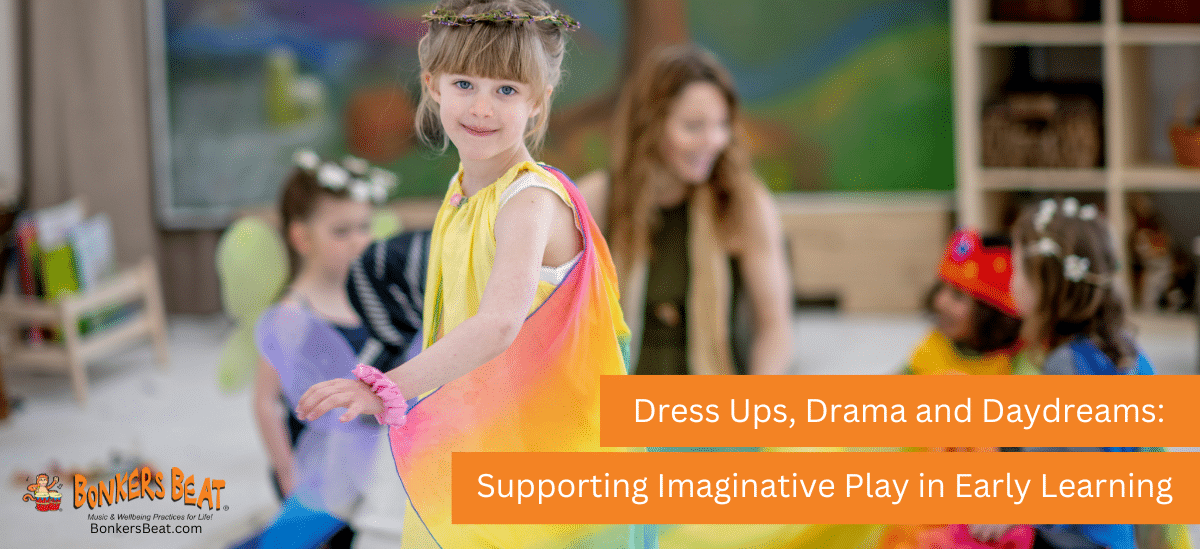
- Offer a costume box: Scarves, hats, aprons, glasses — fill the costume box with wearable items and props that spark ideas and promote self-expression.
- Use music to inspire characters and stories: Acting out song lyrics, dancing like animals, or even composing a theatrical group performance that tells a story.
- Incorporate puppets or soft toys: Sometimes this can be a more accessible bridge to encourage storytelling and communication, especially for children who are still developing confidence in group settings.
- Join in the play! When educators participate without leading, children feel validated and empowered to take part!
Imaginative play is a window into a child’s thoughts and feelings. It’s also a way for them to make sense of their world and practice real-life skills in a safe, supported environment.
With the right encouragement, it can become a powerful tool for learning and development.
If bringing more imaginative play with music, movement and wellbeing practices is on your agenda, you might like to explore how Bonkers Beat programs support holistic development in early childhood education here.