

Planting the Seeds of Curiosity This National Science Week

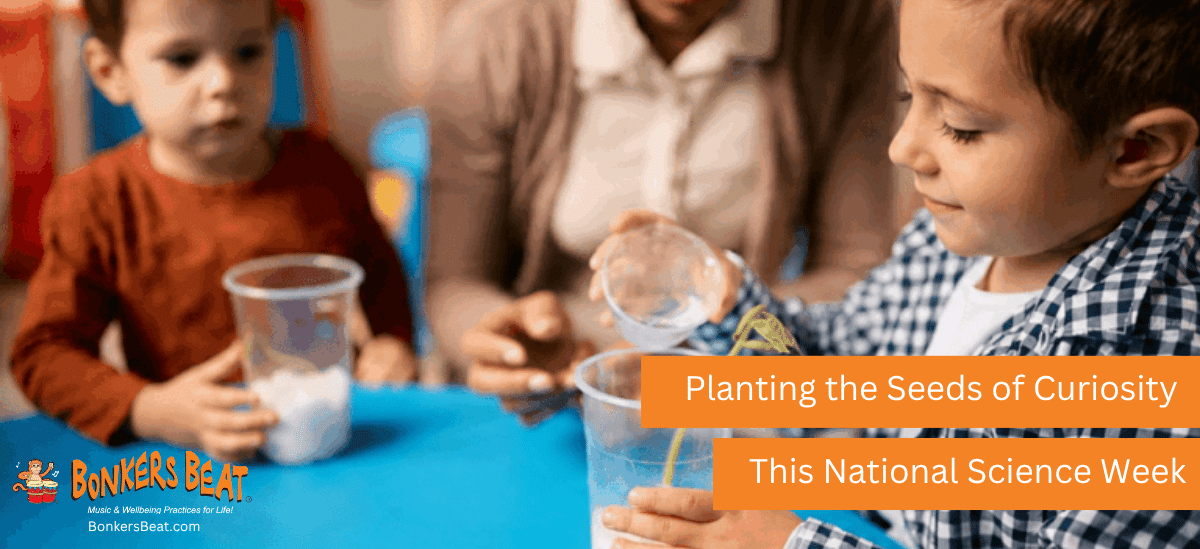
Young children are already scientists. They pour water from one container to another to see what happens. They test how high they can build towers, they watch ants crawl across the ground, and ask questions adults don’t always know how to answer.

That natural curiosity is exactly what Science Week celebrates!

Held from 15-23 August 2026, this year’s theme is Seeds of Science: nurturing science for all. Scientific thinking begins long before children encounter laboratories, textbooks or complicated terminology. It begins with noticing something interesting and wanting to know more – and isn’t that what early childhood education is all about!

Science is a way of thinking

For children, science is less about finding the “right” answer and more about learning how to explore a question.

-What do you notice?
-What do you think might happen?
-How could we test that idea?
-What changed?

These simple prompts can be used by educators during planned learning experiences, but they work just as naturally at home. A puddle, a shadow, a mixing bowl or a collection of leaves can all become the beginning of an investigation.

The adult doesn’t need to know every answer, either.
Saying, “I’m not sure, how could we find out?” shows children that learning is something we can do together and that curiosity is fun at any stage of life.

Small investigations, big discoveries

Science Week activities don’t need to be elaborate. Some of the richest learning can come from slowing down and looking more closely at familiar things.

You might try:

Seed experiments: Plant two seeds and change one growing condition, such as the amount of light or water. Invite children to predict what will happen and record the changes through drawings or photographs.

Music and sound exploration: Explore the science of sound by humming, clapping, tapping different surfaces or playing simple instruments. Can children feel the vibrations? Which sounds are loud, soft, high or low?

Melting experiment: Place ice cubes in different locations and observe which one melts first. What might be causing the difference?

Floating test: Test which objects float or sink, then encourage children to sort, predict and test their ideas.

The result doesn’t have to match the prediction. In fact, an unexpected result often gives everyone more to talk about!

Children begin to understand that changing their minds when they discover something new is part of learning, not a mistake.

Let the questions travel

Science can also create a wonderful bridge between early learning services and home.

An investigation started at a centre might continue around the dinner table or in the backyard. Families could share photographs, observations or funny comments from their child, which can then be revisited by the group.

Questions can travel in the other direction, too. A child might arrive wondering why the moon was visible during the day, why toast changes colour or where snails go when the ground is dry. These everyday observations can inspire shared projects that reflect what children are genuinely curious about.

When educators and families both make room for children’s questions, learning becomes part of everyday life.

For children aged 2–5, we also recommend using the official National Science Week Early Childhood Resources. They were created specifically for Australian early childhood educators in partnership with the Centre for Advanced Studies in Education at the University of Canberra. The activities are aligned with the EYLF and use simple, everyday materials.

Our top recommendation is National Science Week Early Childhood Resources (Ages 3–5)

It includes beautifully designed educator guides and family postcards for activities such as:

  • 🫧 Bubble Science – explore shapes, size and movement.
  • 🔊 Sound Explorers – investigate how sounds are made using simple instruments.
  • 🤖 Robot Adventures – introduce coding and technology through playful movement.

These activities are engaging, easy to set up, and perfect for childcare centres and kindergartens.

But we also have a bonus resource for you! National Science Week DIY Science Experiments

This collection includes videos and instructions for simple experiments. For 2–5 year olds, I especially recommend:

  • 🌈 Rainbow Skittles (colour diffusion)
  • 💧 Upside-down Water (surface tension)
  • 🥬 Red Cabbage Indicator (colour-changing science)
  • 🫧 Bubble investigations

Keep nurturing curiosity

Curiosity doesn’t need to be limited to Science Week! We can nurture it whenever we pause to wonder with a child, encourage them to test an idea or take their unusual questions seriously.

Those small moments plant the seeds for confident thinking, creative problem-solving and a lifelong love of learning.

At Bonkers Beat, music, movement and play open the door to discovery every day. Our Bonkers Beat shop brings together music, language, art and science through engaging activities that can be enjoyed in early learning settings or at home.

Share This

Related Posts