
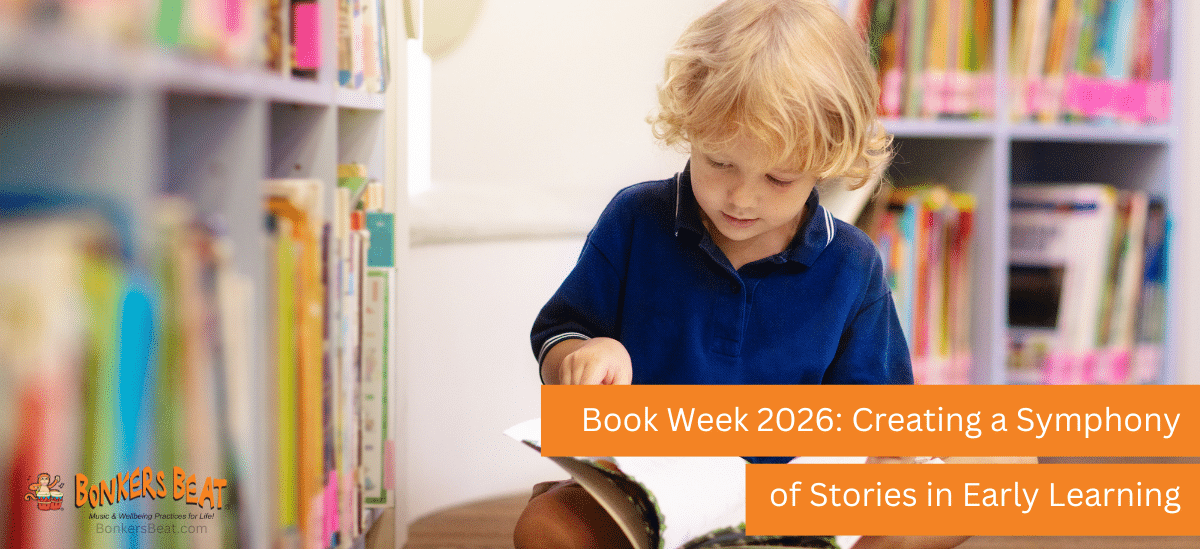
Children’s Book Week 2026 runs from 22–28 August, with the beautiful theme Symphony of Stories.
It’s a perfect theme for early learning because, with young children, stories rarely stay quietly on the page for long!
Some stories are whispered. Others arrive with stomping feet, dramatic voices, giggles, sound effects and a chorus of children calling out the next line before you’ve even turned the page.
This Book Week, let’s bring stories to life through music, movement, imagination and play — and discover how reading can become an experience children look forward to again and again.
Storytelling with the Whole Body
For young children, reading is much more than listening to words.
They watch your face, notice changes in your voice, respond to rhythm and repetition, join in familiar phrases and use their whole bodies to explore what characters might be feeling.
A story can become:
🎵 A chant — when a familiar phrase is repeated together.
💃 A dance — when children move like a character.
🥁 A rhythm — when footsteps, rain or a train become sounds to make together.
🎭 A drama — when children take on different characters and act out the story.
For example, the rain in a picture might inspire tiny fingers tapping on the floor. A sleepy bear might invite slow, heavy movements. A character rushing through the forest might become a fast rhythm of clapping feet.
When children listen, move, copy, predict, remember and invent, they aren’t simply hearing a story — they are becoming part of it.
Try this at your next story time
Pause during a favourite book and ask:
How would this character walk?
What sound might be hiding behind that door?
Should we move quickly, slowly, quietly or heavily?
And remember: there is no need for everyone to respond in the same way.
One child may leap straight into the action. Another may watch carefully before joining in. Someone else might contribute one tiny sound at exactly the right moment.
All of these responses are part of the story.
Let Children Become the Conductors
A symphony comes to life when many different sounds, instruments and performers listen to one another.
The same idea can transform group storytelling.
Invite children to choose sounds, movements or characters for a familiar story. Then give one child the very important job of conductor.
They might signal when the story begins, raise their hands to make the sounds louder, lower them for softer sounds or bring everyone to a dramatic stop.
Suddenly, a simple book becomes a shared musical experience.
And while children are having fun, they are also practising valuable skills — listening, turn-taking, memory, cooperation, self-expression and confidence.
Sometimes the best learning happens when children don’t realise they are learning at all.
Make Room for Many Voices
Book Week is also a wonderful opportunity to explore whose stories are being heard.
Create a reading space filled with books that reflect different families, cultures, languages, abilities and ways of life. Invite families to share a favourite book, rhyme, song or story from home.
And don’t worry if the story isn’t in English.
A story told in a child’s home language can be a beautiful way to strengthen identity, connection and a sense of belonging. It also sends an important message:
Your language. Your family. Your story. They all belong here.
Children can become authors, too.
Record a story they invent during play. Turn their drawings into a class book. Ask them what happens after the final page. Let them create a new ending or invent a character who joins the story.
When children see their own words, ideas and imagination treated as stories worth sharing, they begin to see themselves as storytellers, creators and confident communicators.
Keep the Story Going
The magic of reading doesn’t have to end when the book closes.
Keep a basket of simple instruments near the reading area. Use a familiar song to welcome children to story time. Revisit a favourite book through movement later in the week. Create a story-inspired art experience, dramatic play area or outdoor adventure.
And at home, you don’t need to create anything elaborate.
A few quiet minutes on the couch, a silly voice, a repeated phrase or letting your child turn the pages can be enough.
Read the same favourite book for the tenth time.
Let your child interrupt.
Ask what they think will happen next.
Laugh at the funny part.
Sing the words if you feel like it.
These little moments build something much bigger than a love of books.
Reading together helps children develop language, vocabulary, listening, imagination, concentration, memory and emotional understanding — while also creating a warm, shared connection between child and adult.
The most important thing isn’t reading the story perfectly.
It’s making children feel that stories are a wonderful place to be.
Every Child Has a Story to Tell
This Book Week, let’s not think of books as something children simply sit and listen to.
Let’s make them something children can hear, see, move, sing, imagine, create and share.
Because when music, movement and storytelling come together, every child can find their own way to join the symphony.
At Bonkers Beat, stories, music and movement are woven into everyday learning, helping educators create joyful experiences that nurture communication, creativity, confidence and connection.
To discover practical ways to bring more music, movement and magic into your curriculum and home, explore the Bonkers Beat Programs or Bonkers Beat Music Kinder.
Happy Book Week — and happy reading, singing, moving and storytelling! ❤️
Galina and the Bonkers Beat Team